Dee Estuary Birding
Monthly Newsletter...
July 2026
Newsletter
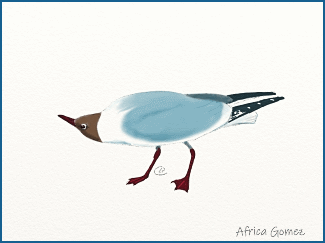
Species Spotlight - Black-headed Gull
Like many other birders, I make a point of visiting
RSPB Burton Mere Wetlands every spring to see Spotted Redshanks, Ruffs,
Avocets, Mediterranean Gulls and Spoonbills. This year there were also
a couple of Garganey and Wood Sandpipers - unfortunately I missed these
- but I was pleased to see a few hundred Black-tailed Godwits and Knots
turning into their summer plumage, and I managed to read a handful of
colour rings.
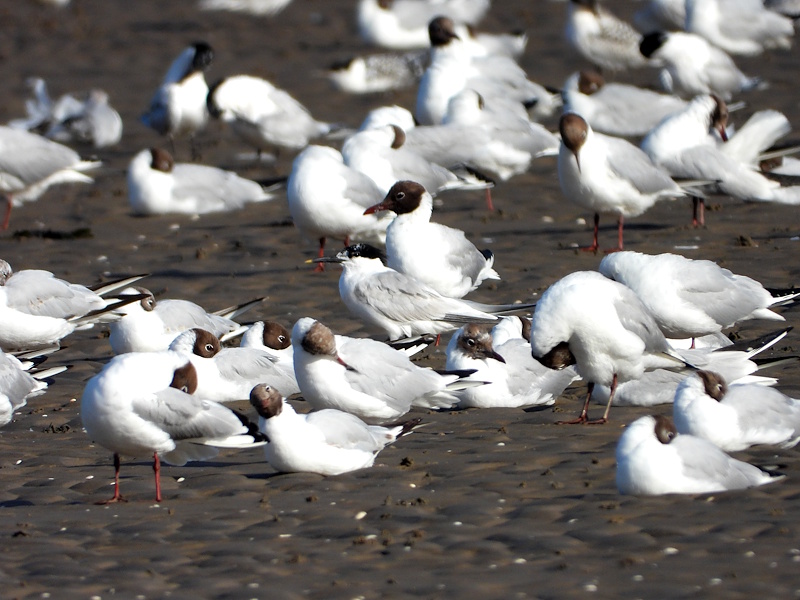
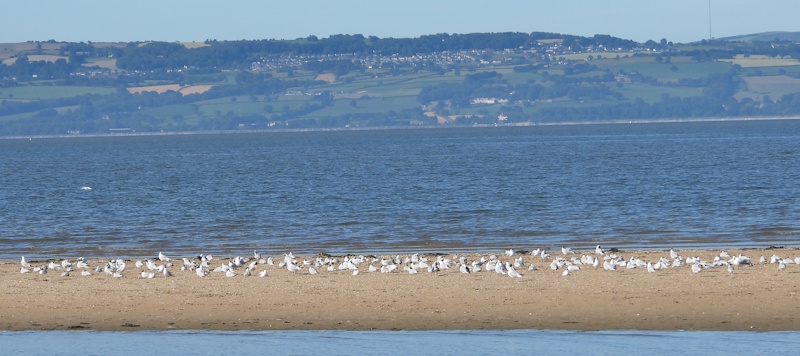
But always, in the background, was the clamour of Black-headed Gulls. With several hundred present the raucous noise was constant. We tend to try and shut it out so we can concentrate on the scarcer species, yet Black-headed Gulls are a fascinating species in their own right, as I describe below.
Breeding Colonies
There are two large colonies on the Dee Estuary with
one at RSPB Burton Mere Wetlands (BMW) and the other at Shotton
Lagoons. In the Cheshire and Wirral Bird Atlas (2008) David Norman
writes that there were 650 nests at Inner Marsh Farm in 2004 and 500 in
2005 (Ref 1). Black-headed Gull colonies are notoriously difficult to
count and
there have been very few published counts since then, but the expanded
reserve (now BMW) had 747 nests in 2022. In 2023 2,000
Black-headed Gulls were present by mid-April and it looked like we were
in for a good breeding season, until Bird Flu* struck and the colony
was largely abandoned. The birds did return n 2024 but the only number
I have is that there were 104 fledged young on the Centenary Pool by
June 27th. On my visits in the spring of 2025 and 2026 there were
several hundreds of breeding pairs but no accurate count was made.
Over at Shotton the colony is managed by the
Merseyside Ringing Group (MRG) who keep detailed records. The average
number of fledglings between 2015-22 was 394 with a productivity of
1.72
(ave fledglings per pair). As with BMW the 2023 season started well
with 1029 nests counted. The impact of the major Bird Flu outbreak
which followed was monitored by MRG and Peter Coffey & Rebecca S.
Verspoor wrote the outcome up in an article for Bird Study (Ref 2). I
briefly summarise - 236 adults (9% of the colony) and 1226 chicks were
found dead, reducing the number of fledglings from 1250 in 2022 to
just 75–100 in 2023. The conclusion in brief was - 'Black-headed Gulls
suffered very
high levels of
chick mortality but modest adult deaths, which were unlikely to have
significantly impacted the colony’s viability'. I should add that their
article also covered the impact of Bird Flu on the Common Terns which
also breed there.
There were fewer nest in 2024, with 771, but 1156 fledglings was a return to normal numbers. 2025 saw a return of Bird flu but with a much lesser impact. There were 715 nests which produced 428 fledglings. Adult mortality was less than 1% but 58% of chicks died, compared to the average of 18.6% in 2016-22 (Peter Coffey pers. comm. June 2nd 2026).
Black-headed Gulls do breed in small numbers
elsewhere on the estuary. Fairly typical were 18 nests at Connah's Quay
NR in 2023 and
54 nests with at least 70 fledglings in 2024, in addition most years
also see a handful of nests on Burton Marsh
* Bird Flu - proper name is Highly Pathogenic Avian Influenza or HPAI.
Post-breeding Gathering and Monthly
Distribution
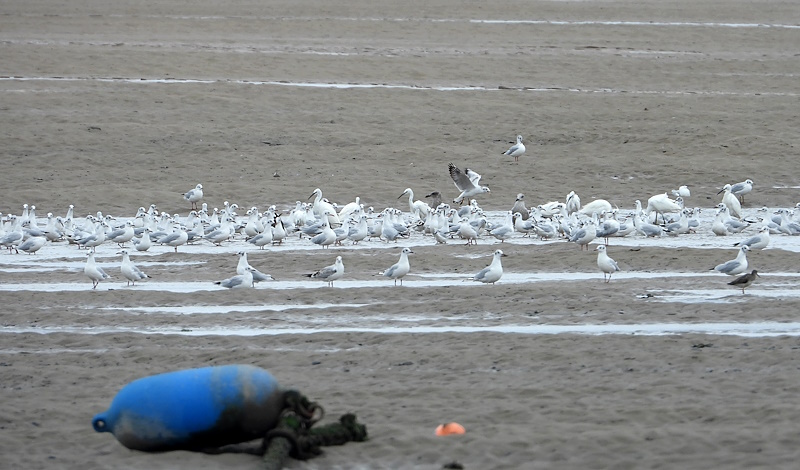
The breeding season finishes in July and that's when we see thousands of Black-headed Gulls in the estuary. Two major post-breeding roost sites are at Heswall and West Kirby and the graph shows the monthly distribution there.
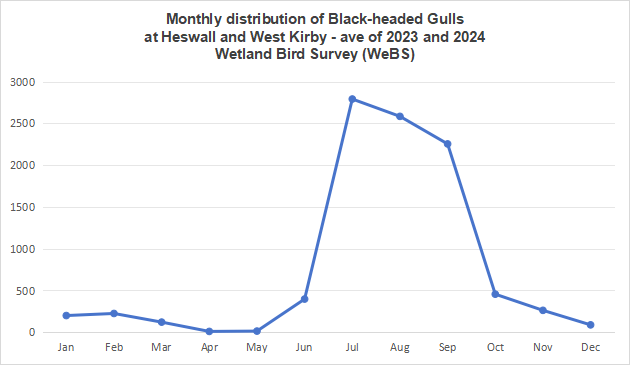
When the birds leave the
breeding colonies they arrive at the estuary with numbers peaking from
July to September. They then disperse, and during the winter they
can be seen just about anywhere - towns, city parks, farmland and along
the coast.
Just 30 miles inland from the Dee Estuary are the
Sandbach Flashes, a site used as a roost in the middle of the Cheshire
countryside, I thought it would be interesting to look at the monthly
distribution there and see how it compares to Heswall and West Kirby.
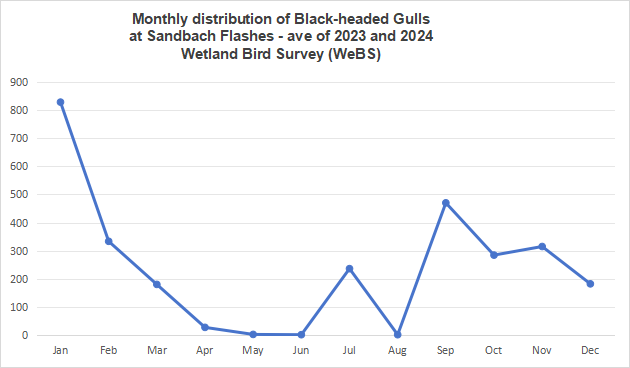
I'm quite surprised just how different this chart is with a big peak in January followed by a rapid fall in numbers as birds return to their breeding colonies between April and June. There are two sizable breeding sites not far from the Sandbach Flashes - 12 miles away is Blakemere Moss, and 15 miles away is Woolston Eyes - and the small rise in numbers in July are probably birds dispersing away from those two sites. In August the birds are still on the coast before they start to return inland in autumn and winter.
Big Counts
As for Heswall and West Kirby the WeBS counts for
the whole of the Dee Estuary peak in summer, nearly always in August.
The five year average is currently 10,737 which means that the
Dee Estuary is the 12th most important wetland site in
the country for this species. But this number pales into insignificance
when
compared to a count made on the Mersey Estuary during a BTO Winter Gull
Survey in January 2025. It was a massive 64,250 and seems to have been
weather related as it was made during an exceptional cold spell. A
similar cold spell in January 2024 also resulted in a high count of
32,000
seen from Hale Head (north shore of Mersey).
In winter, December to February, there is a big
influx of
Black-headed Gulls into the UK from the continent, so
it's no surprise that is when the biggest counts are made. For
example, in the south-east of England there were 31,922 on Abberton
Reservoir and 22,690 on Bewl Water, both counted in the same month as
that massive Mersey Estuary count. You may ask why we don't see such
large numbers on the Dee Estuary, the answer is we do have some but
these big winter flocks are transient and rarely get picked
up by the regular monthly wetland bird counts. The table below shows
some sizable flocks at various Dee Estuary site counted over the past
few years as reported in the Bird Reports.
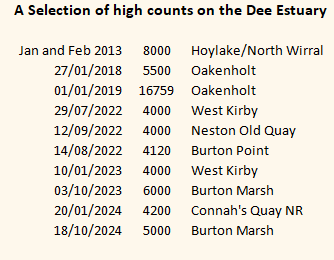
Half of these high counts were in January when
numbers in the whole of the UK peak. Some of them were associated with
freezing conditions and others were during spring tides when the sea
covers the marsh releasing a load of food items for the gulls. I've
included a count from 2013 as there were exceptional numbers of gulls
for several weeks along North Wirral that year, apart from the 8,000
Black-headed
Gulls there were up to 20,000 larger gulls making for quite a spectacle.
Migration
John Coulson, in his book 'Gulls' (Ref 3), analysed ringing data and reckoned that about 70% of wintering Black-headed Gulls in Britain and Ireland originated from the continent. They don't disperse evenly across the country, though, and that figure rises to 80% in the south and east of England, whilst here in North-west England and North Wales the figure is 40%. Over the years many Black-headed Gulls have been ringed so we have a good idea of their movements.
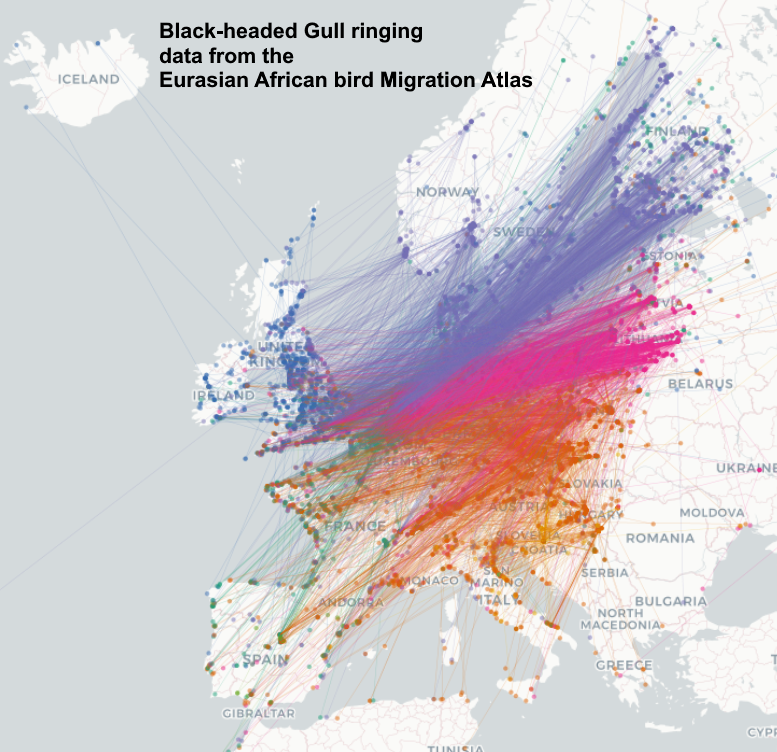
This rather busy map gives a good idea of Black-headed Gull movements
and tells us
two things in particular. 1.) that there is a very strong north-east to
south-west movement (and vice versa) from the countries around the
Baltic to the UK, northern Netherlands and Belgium, and, 2) that there
is very little movement south by British breeding birds (Ref 4).
Just to put some numbers on this. According to the
latest WinGS (Winter Gull Survey 2023/24 and 2024/25, Ref 5) the total
number of wintering Black-headed Gulls in the United Kingdom is
1,100,000. Assuming a split of 70/30 this means 770,000 fly in from the
continent and the remainder, 330,000, are British breeding birds (plus
non-breeding immature birds).
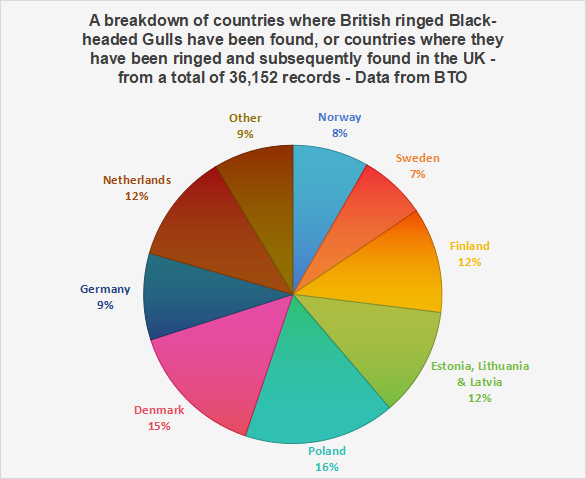
This pie chart confirms the origins of these incoming continental
birds. The 'other' segment includes recoveries from France (1.8%) and
Portugal & Spain (0.7%), confirming that there is only a very small
movement south to these countries (Ref 6).
Colour Rings on the Dee Estuary
A small group of colour ring spotting enthusiasts,
myself included, have been recording colour-ringed birds on
the Dee Estuary and North Wirral over the past 20 years or so, and in
total we have details of 75 ringed Black-headed Gulls**. Thirty four
were
ringed at various sites across the UK and have only ever been recorded
in this country. A further forty one are shown in the map below, these
are birds which have been ringed abroad before arriving here. or ringed
within the Dee Estuary area and subsequently recorded across Europe
and down to north Africa.
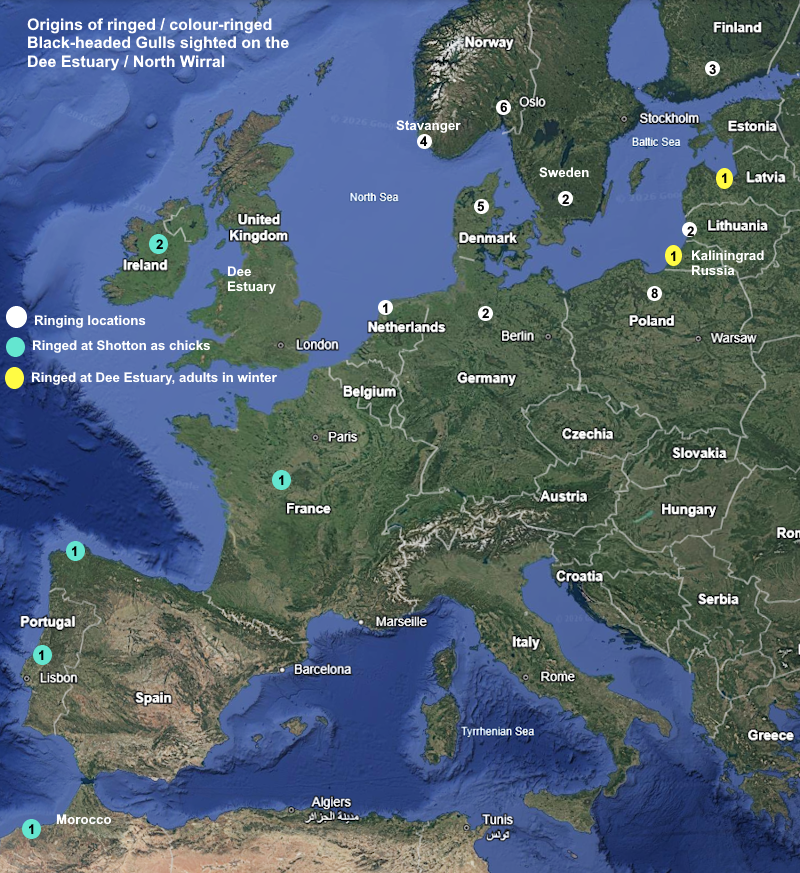
The map shows the number of ringed Black-headed
Gulls from each country, with most birds coming from countries which
border the Baltic Sea, plus Norway which has the highest number
with 10, split between Stavanger and Oslo. This more or less ties in
with what the above European migration
map and pie chart show, but what is interesting is the dispersal of the
young birds south from Shotton (light green circles). You will recall
that the ringing
records for the UK as a whole shows little southward movement, so this
was unexpected. These were ringed as chicks and found in their first
year, so definitely immature birds.
Some of our over-wintering Black-headed Gulls are
very site faithful appearing year after year at the same location,
they are like old friends and we always look forward to their return
after the
breeding season. Two of our favourites are described below.

TMEN - our star bird! It was ringed as a breeding male in Poland in
April 2013, and I was the first one to see it on the pontoon at West
Kirby Marine Lake the following September. It's been recorded every
winter since, last seen in January 2026, and we look forward to
it's return this autumn.
In total it's been sighted 79 times on the Dee
Estuary/North Wirral - 74 of those were at West Kirby, usually on the
pontoon but sometimes on the sand between the lake and Tansky
Rocks/Little Eye. Elsewhere, there have been two sightings from Hoylake
and one each from Greenfield dock, Meols and Thurstaston. The very
definition of 'site faithful'!
It has been recorded back in Poland, in March 2022
and June 2025. The earliest we've seen it here after the breeding
season is July 7th (2014) and the latest date is March 4th (2018).
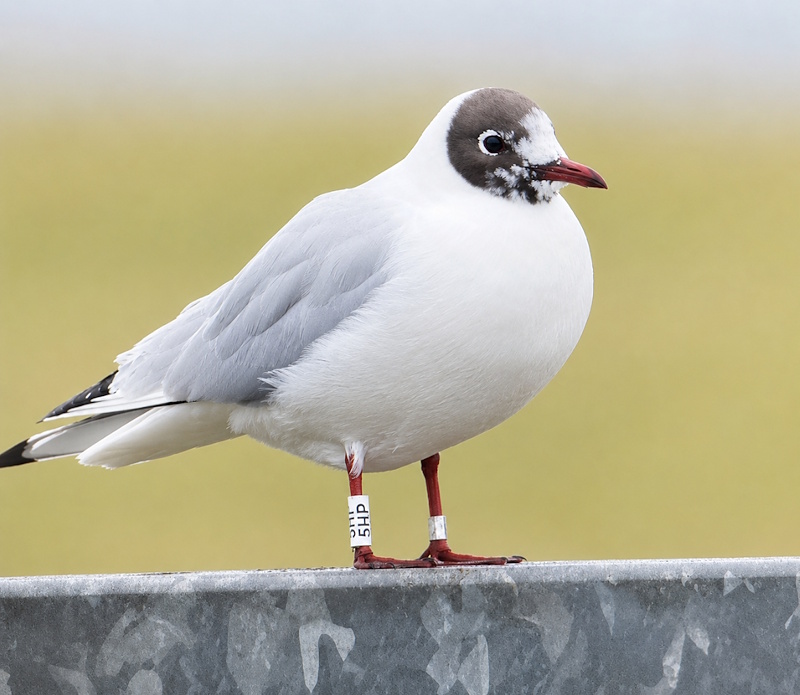
5HP was ringed at Damhussoen Lake in Copenhagen in
March 2015. It's first record after breeding was in July 2015 at New
Brighton Marine Lake. Since then it's been recorded a further 32 times,
usually on the 'Dips' at New Brighton (the grassy area inland of the
'prom'). There's been just two records away from New Brighton,
it was seen again in Copenhagen in July 2019 and at Seaforth in August
2020. It was last seen, at New Brighton, in January 2023.
**I am aware that many more records of ringed Black-headed Gulls have been gathered by the Merseyside Ringing Group, and others, over many decades. Hopefully they will agree that our small sample of relatively recent records is of interest and gives a good idea of the movements of Black-headed Gulls recorded in the Dee Estuary and North Wirral.
References
1. David Norman (editor), Birds in Cheshire and Wirral - A breeding and wintering Atlas, Liverpool University Press, 2008.
2. Peter Coffey & Rebecca S. Verspoor, Case study of the impact of an outbreak of high pathogenicity avian influenza (HPAI) on a seabird colony in Flintshire, Wales, United Kingdom, Bird Study Volume 72, 2025 - Issue 1.
3. John C. Coulson, Gulls, The New Naturalist
Library, 2019.
4. Spina F. et al., The Eurasian African bird Migration Atlas, https://migrationatlas.org/, 2022.
5. Ian Woodward and Emma Caulfield BTO, Gull Galore
(winter Gull Survey), Waterbirds in the UK 2024/25 Summary Report, Page
16 (also see Species Focus - Black-headed Gull on Page 22).
6. Online Ringing and Nest Recording Report,
BTO, https://www.bto.org/,
2025.
In addition various sources have been used to obtain counts mentioned in this article, including:
- Dee Estuary Birding Website - http://www.deeestuary.co.uk/
- Various Cheshire & Wirral Bird Reports and North-east Wales Bird Reports.
- WeBS Report Online, Numbers and Trends (Click Here).
Richard Smith
Colour Ring Report
Avocet
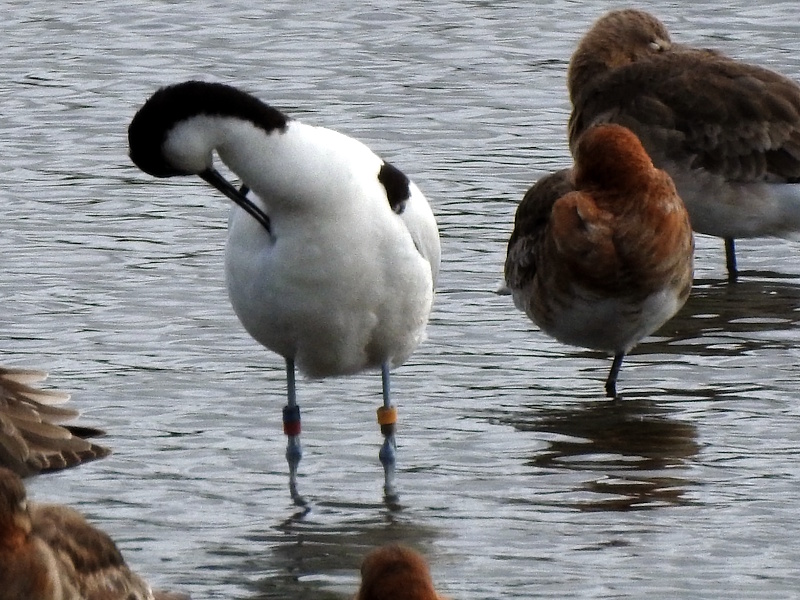
Ym-BR
Ringed at Kenhill Marsh, near Heacham, Norfolk, as a chick in
June 2002.
Recorded at Burton Mere Wetlands on 16/03/2025 and 05/06/2026.
This bird went 'missing' for 23 years after ringing.
I wonder where it was hiding? When found in June this year, at
BMW, it was 23 years 11 months and 16 days after being ringed as a
chick - a good age. According to the BTO Online Ringing Report this
makes it the fifth oldest Avocet ever found in Britain & Ireland,
the oldest being 32 years 11 months 3 days.
Roseate Tern
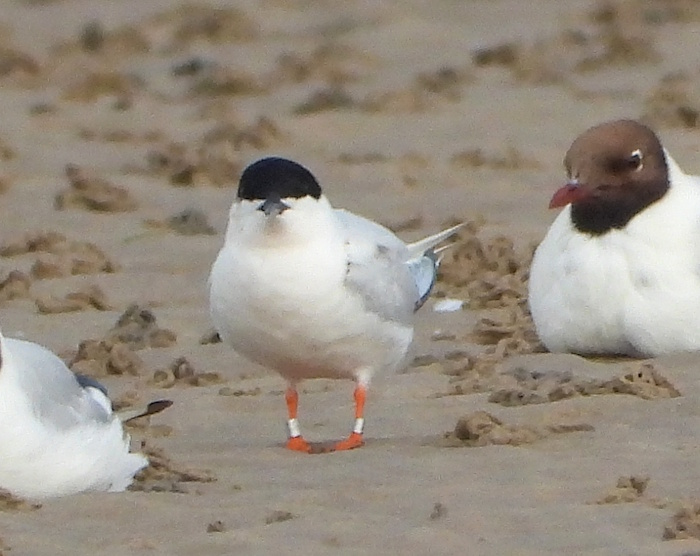
There is a better photo in the 'Bird News' section below but this one shows the rings well,
including a 'Roseate Special' on the right tarsus.
A lot of ringed Roseate Terns are fitted with what is called a 'Roseate
Special' metal ring with a four character code which is readable in the
field. It is the larger of the two rings and on this bird, above, is on
the right tarsus. Unfortunately, despite many photos being taken we
were unable to read any marks on the ring. However, the placement of
the 'special' ring on the right means it was almost certainly ringed in
Ireland (those ringed on Coquet Island have it on the left). The most
likely site is Rockabill where there is a large colony of around 1,700
- 1,800 pairs. Rockabill consists of two small islands about four miles
off the Irish coast north-east of Dublin, and is by far the biggest
breeding colony in the British Isles. Thankfully, this colony was only
lightly affected by Bird Flu and the number of breeding pairs has
actually increased recently - from around 1,600 pairs in 2020 to 1,776
pairs in 2024 when a detailed count was made.
Update 06/07/2026: Stephen Newton confirms that this
bird is from Rockabill, they stopped using the two metal rings (with
the 'Roseate Special) in 2017 so this bird must be at least ten years
old.
Thanks to Colin
Jones and Steve Williams of the Hilbre Bird Observatory for help with
obtaining information about the Roseate Terns.
Sandwich Terns
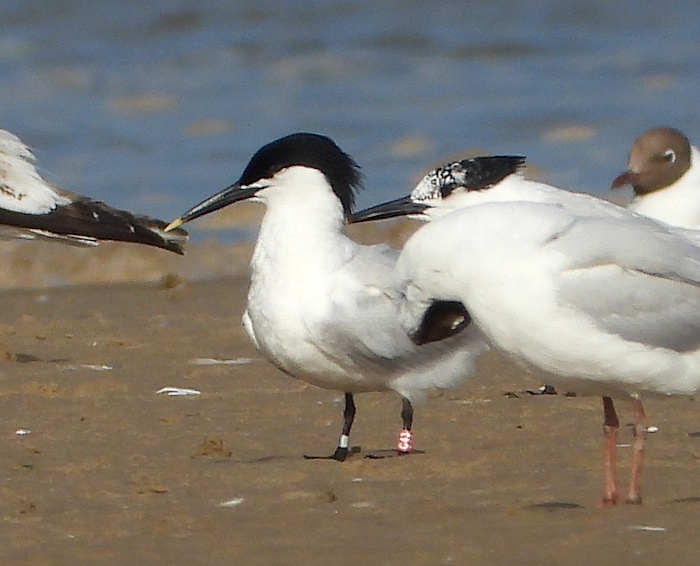
Red (C43)
Ringed at Hodbarrow, Cumbria, in June 2024 as a chick.
Recorded at Formby four times between 20/07/2024 and 07/08/2024 when it
moved to Hafan-y-mor, near Criccieth, where it was spotted in early
September, presumably starting it's journey south.
There were no records in 2025 so presumably, as an immature bird it
stayed in African waters.
It was recorded at West Kirby on 25/06/2026.
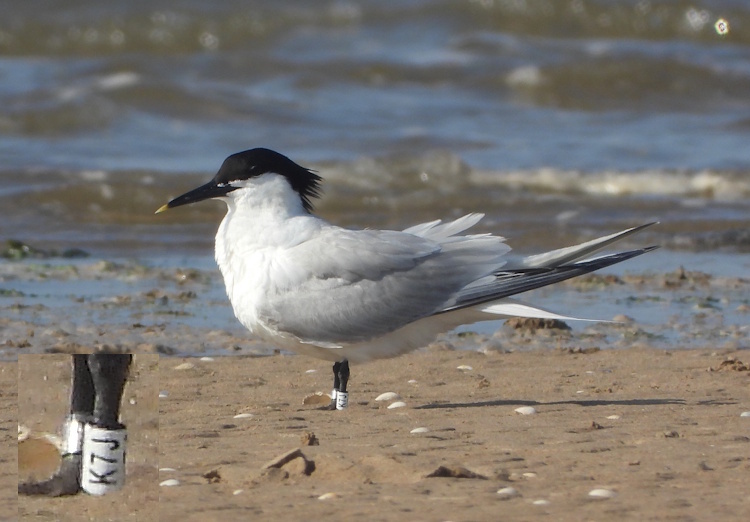
White (K7J)
Ringed at Lady's Island Lake, Wexford. in June 2016. as a chick.
It was not seen again until it turned up in Cadiz harbour in August
2020, followed by single sightings at Rhos Point (North Wales) in
September 2021 and August 2023.
Following my sighting of it at Hilbre in mid-August 2024 it then became
a regular around Liverpool Bay with further sightings that August
at
Seaforth and Rhyl.
July 2025 saw it again at Hilbre followed by no less than eight records
at Formby, plus two records at Rhos Point, up to the end of August.
It was recorded at West Kirby on 26/06/2026.
Since being ringed it has never been seen at a
breeding colony so we don't know where it breeds. It's appearance at
West Kirby in June suggests it was a failed breeder this year.
Colour Rings were recorded by Richard
Smith and Stephen
Hinde.
Richard Smith
June Bird News
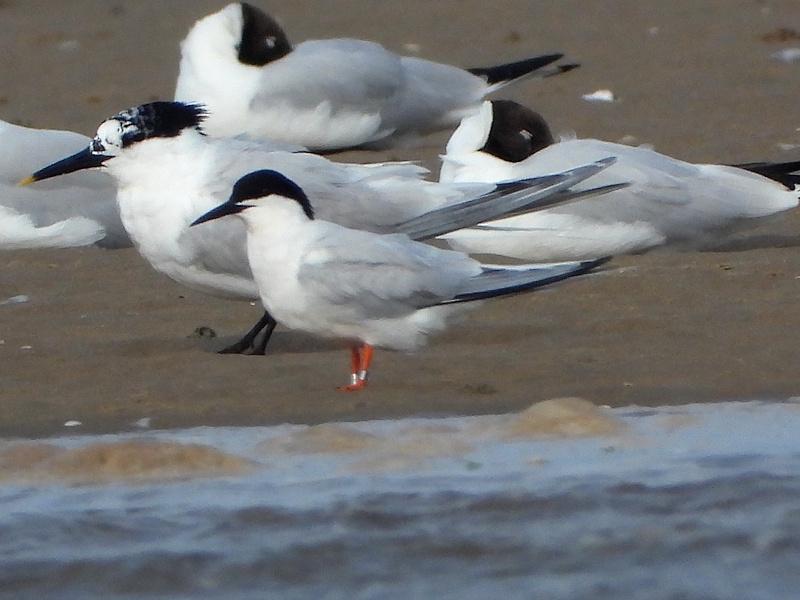
This Roseate Tern was on West Kirby Shore with about
30 Sandwich Terns and 6 Common Terns on the 25th (read more about this
bird in the Ringing Report above). They are less than
annual here on the Dee Estuary/North Wirral with the last two records
being at Gronant in July 2024 and two which flew past Leasowe Bay in
July 2022. Interestingly, the last two years has seen an increase in
sightings of Roseate Terns within the Common Tern colony just across
the Mersey at Seaforth and there were up to four there in June, with
six seen on Formby Shore.
At least eight Glossy Ibis, flying north past Parkgate on the 24th, was an intriguing record. It's likely that these were non-breeding 2cy birds of which there will be many in western Europe after the exceptional breeding season in 2025. Last year's big influx into the UK was in September - and from what I hear we can expect the same this autumn with, apparently, an even better breeding season in Donana National Park (SW Spain) this year.
There was little indication of a late passage of waders going north but we did have quite a few over-summering with us - these included 630 Knot, 485 Black-tailed Godwits and 44 Bar-tailed Godwit at Burton Mere Wetlands on the 10th and 300 Bar-tailed Godwit and 600 Knot at Point of Ayr on the 15th. There were also eight Whimbrel at Point of Ayr on the 15th with one or two later in the month at Heswall and West Kirby.
Returning waders started arriving around the 22nd with two Green Sandpipers at Decca Pools and a Greenshank off Leasowe. A few days later Decca Pools had four Little Ringed Plovers, two Common Sandpipers and three Green Sandpipers, and there were five Spotted Redshanks at Burton Mere Wetlands by the 24th.
Several pairs of Mediterranean Gulls bred around the head of the estuary (most at Burton Mere Wetlands) and they started to return to the Heswall gull roost with four on the 22nd and 10 on the 28th. By the end of the month there were at least 40 Sandwich Terns at both West Kirby and Hilbre.
Despite some strong westerly winds sea-watching was disappointing although three Arctic Skua off Leasowe Gunsite on the 2nd was an excellent record. Elsewhere, there were 12 Manx Shearwaters and 24 Gannets off Hilbre on the 14th.
There were at least two calling Quails on Burton
Marsh, heard several times, whilst one on the new marsh on Hoylake
shore was more unexpected. A Barn Owl was seen several times hunting
over
the marsh at Parkgate and there were up to six Spoonbills there.
What to expect in July
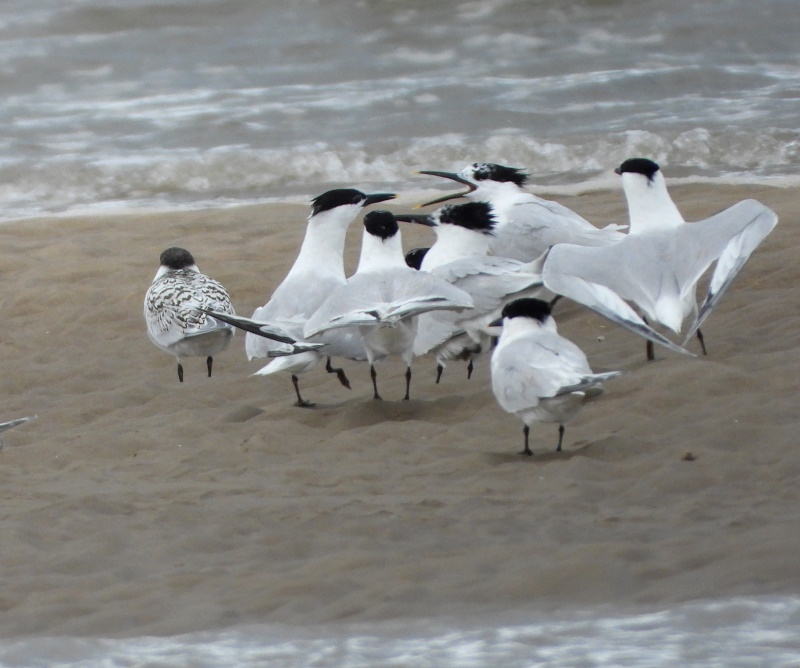
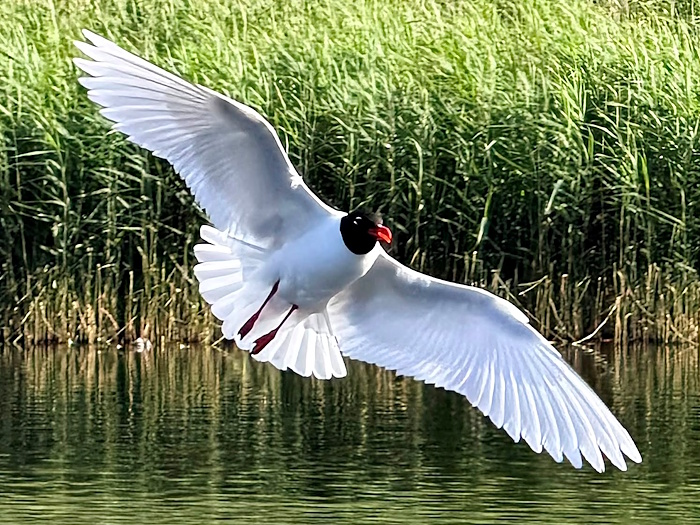
You will know from the above article that there will be a big influx of Black-headed Gulls in July, and they will be joined by Mediterranean Gulls which always look splendid in summer plumage, and there can be 30 or more off Heswall and Thurstaston but, perhaps, closer views can be had at West Kirby and along North Wirral, as well as Point of Ayr on the Welsh side. I've mentioned the noise Black-headed Gulls make when breeding but that's nothing compared to the racket Sandwich Terns make - filling the estuary with their kirrick kirrick calls in July and we should see several hundred. By mid-month we will hopefully see plenty of juveniles.
Waders will be returning in their thousands - I love to see the Black-tailed Godwits arriving in their spectacular breeding plumage and numbers at Caldy should reach at least 4,000 by the month-end. Less spectacular but just as welcome will be the return of the Redshanks and we will have over 3,000 at Heswall. Greenshanks will be passing through with Parkgate being a favoured site. Common Sandpipers can be seen just about anywhere, on the coast or on inland fresh water - the stretch of the River Dee from Connah's Quay to Queensferry seems to be particularly attractive to them with numbers well into double figures. We sometimes see one or two adult Curlew Sandpipers in July, although it will be several weeks before the juveniles start coming through.
On the marshes look out for Spoonbills and Marsh Harriers, and maybe an early Hen Harrier. Out to sea a fresh westerly wind is likely to bring in Manx Shearwaters and one or two Arctic Skuas, and Storm Petrels are always a possibility.
July can be good for rarities and over the past few
years we've had Long-billed Dowitcher, Hoopoe, Melodious Warbler,
Roseate Terns and a Night Heron.
July Highest
Tides (Liverpool Gladstone Dock):
15th 12.37hrs (BST) 9.4m
16th 13.26hrs (BST) 9.4m